<?xml version="1.0" encoding="utf-8"?><feed xmlns="http://www.w3.org/2005/Atom" ><generator uri="https://jekyllrb.com/" version="4.3.3">Jekyll</generator><link href="https://baarbe.com/feed.xml" rel="self" type="application/atom+xml" /><link href="https://baarbe.com/" rel="alternate" type="text/html" /><updated>2024-09-23T14:45:23+00:00</updated><id>https://baarbe.com/feed.xml</id><title type="html">Jeremiah Baarbe</title><subtitle>Experienced IP and tech lawyer, data nerd</subtitle><author><name>Jeremiah Baarbe</name></author><entry><title type="html">Open data brings farmers and researchers together</title><link href="https://baarbe.com/open%20data/open-data-brings-farmers-and-researchers-together/" rel="alternate" type="text/html" title="Open data brings farmers and researchers together" /><published>2017-09-19T00:00:00+00:00</published><updated>2017-09-19T00:00:00+00:00</updated><id>https://baarbe.com/open%20data/open-data-brings-farmers-and-researchers-together</id><content type="html" xml:base="https://baarbe.com/open%20data/open-data-brings-farmers-and-researchers-together/"><![CDATA[<p><em>Cross-posted on <a href="http://openair.org.za/open-data-brings-farmers-and-researchers-together">Open AIR’s website</a></em></p>

<p>How can farmers and researchers use open data to work together for food security?</p>

<p>Agricultural research is changing as researchers and farmers are seeing the benefits of working together. Farmers enjoy solutions and best practices proven by research. Researchers benefit as they gain access to grounded knowledge and experience. Open data and other forms of open access to knowledge help facilitate these relationships.</p>

<p>On September 19th, 2017 I represented <a href="http://openair.africa">Open AIR</a> and <a href="http://godan.info">GODAN</a> in a webinar hosted by <a href="http://www.gfar.net/">GFAR</a>, the Global Forum on Agricultural Research and Innovation. The webinar focused on how farmer rights facilitate and frustrate cooperation with researchers. You can watch my talk and the whole video below. Scroll to 1h 30m for the beginning of my talk.</p>

<iframe align="middle" width="560" height="315" src="https://www.youtube.com/embed/xQ9c2_nbtBc?start=5393" frameborder="0" allowfullscreen=""></iframe>

<p>Open data, in particular, brings farmers and researchers together. In our digital economy, data is now <a href="https://www.economist.com/news/leaders/21721656-data-economy-demands-new-approach-antitrust-rules-worlds-most-valuable-resource">the worlds most valuable resource</a>. This is especially true for agricultural data, which has become as important as land and labour in managing farms. Agricultural data is found across the food-production chain. Governments make policy based on land use data, farmers rely on data to decide when to plant crops and what price to ask for their crops at market, and scientists use data to drive their research.</p>

<p>Opening agricultural data facilitates communication, spreading the benefits across the data ecosystem. Scientists gain access to important data sources, often directly from farmers. Developers are able to build innovative tools. Farmers gain access to new insights and ways to make decisions. These benefits are part of why <a href="http://www.godan.info">GODAN</a>, the Global Open Data for Agriculture and Nutrition sees open data as key in meeting Sustainable Development Goal 2 of <a href="http://www.undp.org/content/undp/en/home/sustainable-development-goals/goal-2-zero-hunger.html">zero hunger</a>.</p>

<blockquote>
  <p>Open data is data that can be freely used, re-used and distributed by anyone – subject only, at most, to the requirement to attribute and sharealike.</p>
  <ul>
    <li><a href="http://opendatahandbook.org/guide/en/what-is-open-data/">The Open Data Handbook</a></li>
  </ul>
</blockquote>

<p>The ability for farmers and researchers to open and access data is controlled by law. These laws, based in intellectual property, identify three categories of stakeholders. They give rights to some stakeholders and responsibilities to other stakeholders. Professor Jeremy de Beer, in a paper published by GODAN, described how laws governing <a href="http://www.godan.info/documents/ownership-open-data-governance-options-agriculture-and-nutrition-0">ownership of data</a> allow some stakeholders to control access and use. Laws that govern use of data include privacy, trade secrets, plant breeder rights, and access and benefit sharing. Arguably, the most important set of laws for governing access to data is copyright, the ability to control who accesses and uses original expressions. Although raw agricultural data cannot be owned under copyright, compilations of data in databases attract copyright and can be owned.</p>

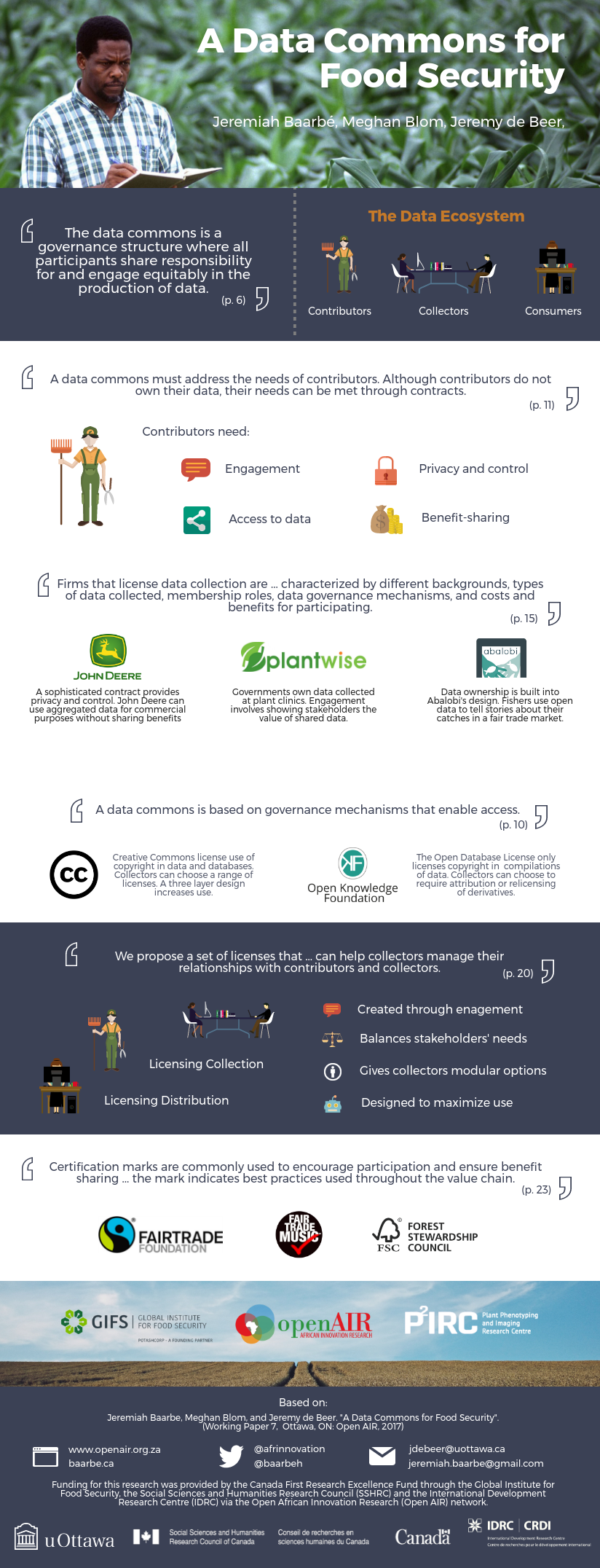
<p>Farmers contribute data, gathered from their fields and crops. Third parties including governments, corporations, and researchers, collect data. Consumers, who may also be farmers, app developers, or other decision makers then consume data. Within this eco-system, copyright law favours collectors, giving them ownership of the data they compile. Consumers can only access data when collectors decide to share or license it. Contributors have few rights once the data is collected. The lack of rights for contributors creates risks, particularly for small-holder farmers. Because farmers are also the source of data, this vulnerability threatens trust and has the potential to limit access to data.</p>

<p>In a recent working paper, <a href="http://www.openair.org.za/publications/a-data-commons-for-food-security/">“A Data Commons for Food Security”</a> my colleague Meghan Blom, supervisor Professor de Beer, and I offer a solution. We propose a model license and social certification scheme based on lessons learned from Creative Commons and the Fair Trade Movement. Once developed, collectors will be able to use the license to meet the needs of contributors. Farmers need engagement in decision of how collectors will use their data, assurances of privacy and control, to receive the benefits of their data, and to have access to data.</p>

<p>I’m excited to share these insights with farmers and researchers at a <a href="https://blog.gfar.net/2017/08/25/join-our-gfar-webinar-farmers-rights/">webinar hosted by GFAR</a> on September 19, 2017.</p>

<p><img src="https://baarbe.com/assets/img/a-data-commons-_23243752.png" alt="A Data Commons Infographic" /></p>

<p><em>“Open AIR is carried out with financial support from the International Development Research Centre, Canada, the Social Sciences and Humanities Research Council of Canada, and Queen Elizabeth Scholars. More information about Open AIR’s current and previous supporters can be found <a href="http://www.openair.org.za/supporters/">here</a>. The views expressed herein do not necessarily represent those of Open AIR’s funders.”</em></p>

<p><img src="https://baarbe.com/assets/img/Open AIR logo on White One-line.png" alt="Open AIR Logo White" /></p>]]></content><author><name>Jeremiah Baarbe</name></author><category term="open data" /><category term="speaking" /><summary type="html"><![CDATA[Cross-posted on Open AIR’s website]]></summary></entry><entry><title type="html">A new blog</title><link href="https://baarbe.com/meta/a-new-blog/" rel="alternate" type="text/html" title="A new blog" /><published>2017-09-15T00:00:00+00:00</published><updated>2017-09-15T00:00:00+00:00</updated><id>https://baarbe.com/meta/a-new-blog</id><content type="html" xml:base="https://baarbe.com/meta/a-new-blog/"><![CDATA[<p>Welcome to my blog! In the coming months I’ll be writing on a variety of topics related to technology and law. I’m also excited to share some of my experiences with you, including my:</p>

<ul class="list-unstyled">
    <li><a href="https://baarbe.com/projects"><i class="em em-wrench"></i> projects</a></li>
    <li><a href="https://baarbe.com/thoughts"><i class="em em-bulb"></i> thoughts</a></li>
    <li><a href="https://baarbe.com/talks"><i class="em em-loudspeaker"></i> talks</a></li>
    <li><a href="https://baarbe.com/publications"><i class="em em-orange_book"></i> publications</a></li>
</ul>

<h3 id="technology-is-changing-our-world-including-the-law">Technology is changing our world, including the law.</h3>

<p>There are many opportunities for technology to disrupt the law. If we travelled back a hundred years and stepped into to hospital in 1917, it would look very different from today. We might convince a doctor to leave their operating room and return to the 21st century with us, but they would not longer be able to practice medicine. Advances in antibiotics, genomics, and stem-cell therapy are some of the technologies that have changed the delivery of health care.</p>

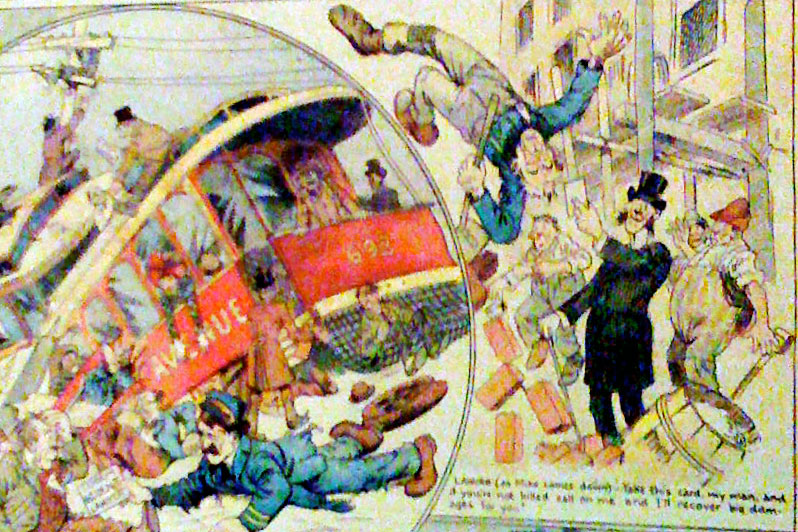
<p><img style="margin-left: -2em;" src="https://baarbe.com/assets/img/LawyerJokes1900Closeup.jpg" alt="Lawyer joke from 1900" /></p>
<div>
<small>"Take my card and call me" the lawyer tells the man falling out of the carriage.</small></div>

<p>Instead, if we entered a court room in 1917 and convinced a lawyer to travel 100 years back with us, they’d quickly be able to represent clients. Compared to advances in medicine, not much has changed in the practice of law. Yes, our legal institutions have evolved, the law has advanced, legal research now involves searching databases instead of stacks of reporters, and lawyers today work in networked offices. But our time travelling lawyer would represent clients using similar arguments, gathered through the same methods of detailing facts and reading cases, and presented in a familiar court setting. These are all areas were technology can increase access to justice.</p>

<p>The technological revolution in law is just beginning. Machine learning technologies are changing how lawyers approach legal problems and perform legal research. Startups like <a href="https://www.mira.law/">Miralaw</a> and <a href="http://www.rossintelligence.com/%22%20%5Ct%20%22_blank">ROSS Intelligence</a> are using AI to build issue spotting and case summary tools. Legal Knowlege Engineers are building apps that help people resolve disputes. British Colombia, for example, has legislated a fully online <a href="https://civilresolutionbc.ca/">Civil Resolution Tribunal</a> to resolve small claims disputes. Smart contract blockchains like <a href="https://blockgeeks.com/guides/what-is-ethereum/">Ethereum</a> are surging in the market. Data-driven litigation intelligence, like that offered by <a href="https://www.loomanalytics.com/">Loom Analytics</a> offers news ways to quantify judicial decision making or quickly perform due diligence for discovery documents. Neural networks like those developed by <a href="https://commonlaw.uottawa.ca/en/people/alschner-wolfgang">Dr. Wolfgang Alschner</a> are <a href="http://mappinginvestmenttreaties.com/specials/rnn-experiment/">writing new treatries</a> with interesting implications for writing treaties and contracts.</p>

<p>The substance of law is also changing as technologies create new social dynamics and legal issues. Legislation, case law, regulations, and our legal institutions are evolving to address these problems. Issues of privacy, ownership of data, and regulation of the internet are pressing topics that generate significant debate. Open access has become a popular tool to share knowledge while managing copyright issues. International treaty negotiations and kegislative review of key intellectual property legislation raise questions about how to facilitate innovation in Canada.</p>

<p>This is an exciting time to be working in technology and law. I invite you to follow and engage with me here, on <a href="https://twitter.com/baarbeh/">twitter</a> and <a href="https://github.com/baarbeh">github</a>. I welcome comments, which you can submit through this <a href="https://jbaarbe.typeform.com/to/BwFIyM">interactive form</a>.</p>

<p><img style="margin-left: -2em;" src="https://baarbe.com/assets/img/sunrise1.jpg" alt="The sun rising above Amboseli, Kenya" /></p>
<div><small>The sun rising across the savannah in Amboseli, Kenya</small></div>]]></content><author><name>Jeremiah Baarbe</name></author><category term="meta" /><category term="thoughts" /><summary type="html"><![CDATA[Welcome to my blog! In the coming months I’ll be writing on a variety of topics related to technology and law. I’m also excited to share some of my experiences with you, including my:]]></summary></entry></feed>